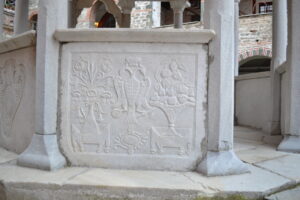
Holy Monastery of Philotheos
31.10.2019
The Monastery was first mentioned in a document from 1013, when it was called "Monastery of Pteris". Two years later it was mentioned by its current name, which seems to be the name of the founder. During the 16th century, its abbot was Saint Dionysios, who later founded the Monastery of Saint Dionysios on Mount Olympus.
In Philotheou, the great saint Kosmas the Aitolian also established a monastery in the 18th century. The Catholicon, dedicated to the Annunciation of the Virgin Mary, was built on the site of the old one in 1746 and frescoed in the years 1752 and 1765.
The altar has 16th century frescoes. Its most important relic is the miraculous two-faced icon depicting the Virgin Mary Glykofilousa on one side and the Crucifixion on the other.
Position
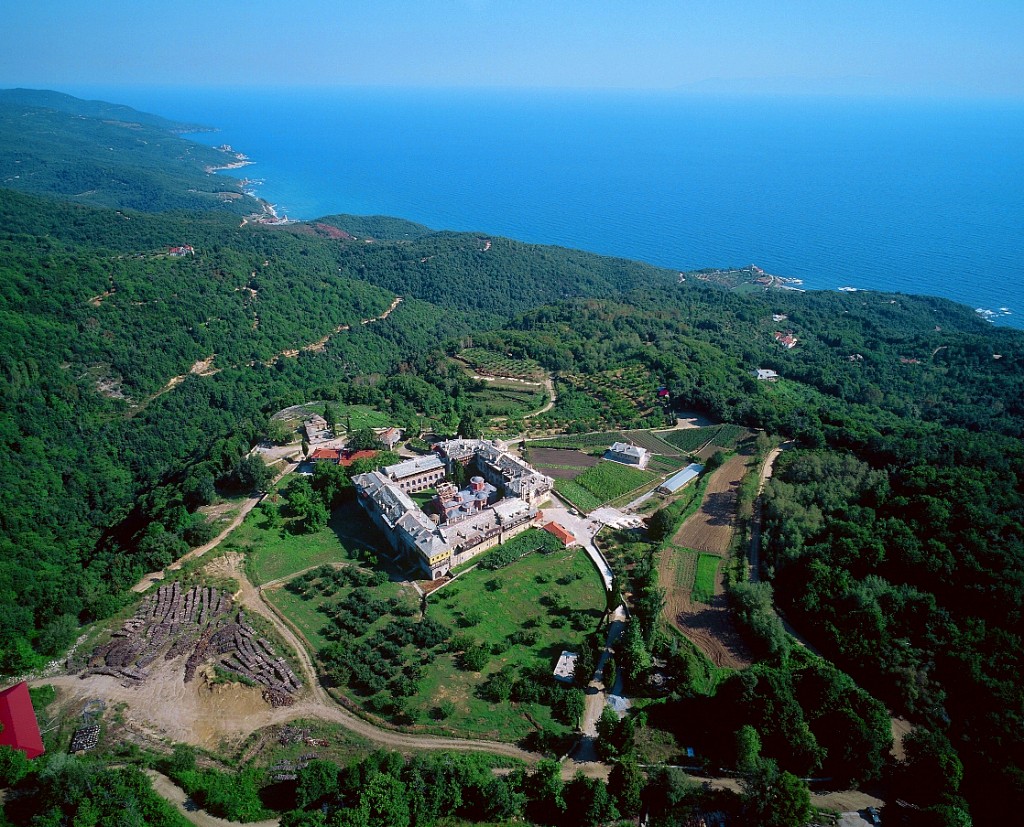
The monastery of Saint Philotheos is located approximately in the middle of the eastern coast of the Athonite peninsula, built on a plateau, at an altitude of approximately 330 meters above sea level, between the Karakallos monastery and the Mylopotamos Seat of the Great Lavra monastery. For the pilgrim on foot, the monastery is estimated to be about half an hour from its arsana and two and a half hours from Karyes. The natural environment of the monastery is dominated by ferns, and for this reason in the early years of its existence it was also known as the Monastery of Fteri.
Founder of the Monastery
According to tradition, the first founder of the monastery is Saint Philotheos, who was a disciple of Saint Athanasius of Athonite. We first encounter it with the name of its founder in the sources in the years 1015 and 1016, where its then abbot, George, signs himself as " George monk and abbot of Philotheos" and as " George, monk and abbot of the monastery of Lord Philotheos " respectively. However, according to the first scholar of Mount Athos Gerasimos Smyrnakis, there seems to have been an old monastery at this location, with the name Philotheos as early as 868, which is not verified by written sources.
Byzantine period
The first major building program of the monastery complex dates back to the reign of Nikephoros III Botaneiates (1078-1081), who made large donations to the monastery. However, the monastery received its greatest benefactions during the reigns of the Palaeologans Andronikos II (1282-1328), Andronikos III (1328-1341) and John V (1341-1391). The reason was the fact that the then abbot of the monastery Makarios was appointed by Andronikos II as spiritual elder of the Palace. As a means of strengthening the monastery, an annual subsidy of ten great talents was designated from the imperial corvanas. Additionally, the same emperor granted the monastery's possessions in Thassos, Serres, Kalamaria, etc. Elder Makarios himself requested the right hand of Saint John Chrysostom for the monastery, which was donated to him along with a gold-plated reliquary. Stefan Dusan attempted to man the monastery of Philotheos in the mid-14th century . The result of his move was that many Bulgarian and Serbian monks came to the monastery.
Ottoman period
A long period follows, during which the sources are silent, which in the bibliographic research is translated as a period of decline and poverty. The Ottoman conquest obviously contributed to this situation, as, as appears in a document of 1541, the Monastery had granted the usufruct of the territorial areas of its metohi in Thassos to villagers. As is known, at this time in the Ottoman Empire, Selim I and Suleiman I reigned, who exercised particular oppression on the Christian populations.
At the beginning of the 16th century , the abbot of the monastery was Dionysios, the later founder of the homonymous monastery on Olympus. He was responsible for the conversion of the monastery from an Idiom to a coenobitic one, as well as the initiation and execution of a broad renovation program, which was based on donations from benefactors. The last benefactors of the monastery include the Russian Tsars Mikhail Theodorovich (1642) and John Maximovich (1707), as well as the rulers of the Transdanubian principalities of the time. A significant date for the monastery is the year 1871, when a fire burned down most of the buildings, except for the Catholicos and the Library. The Bank was partially saved, as well as a small part of its entrance passage, on which an inscription with the date 'ζμη' (7048-1540) was preserved.
Saints of the monastery
A Philotheite monk was Saint Cosmas the Aetolian, known for his support of Christian populations throughout western Greece, as well as the provinces of the old western Illyrian region. However, among the saints who settled as monks in the Philotheos monastery are many others, perhaps less well-known, such as Symeon the Barefoot and Monastic from Agia Magnesia, Saints Dometios and Damianos from Agrafa, Saint Dionysios from Fanari, Karditsa, etc.
The monastery complex
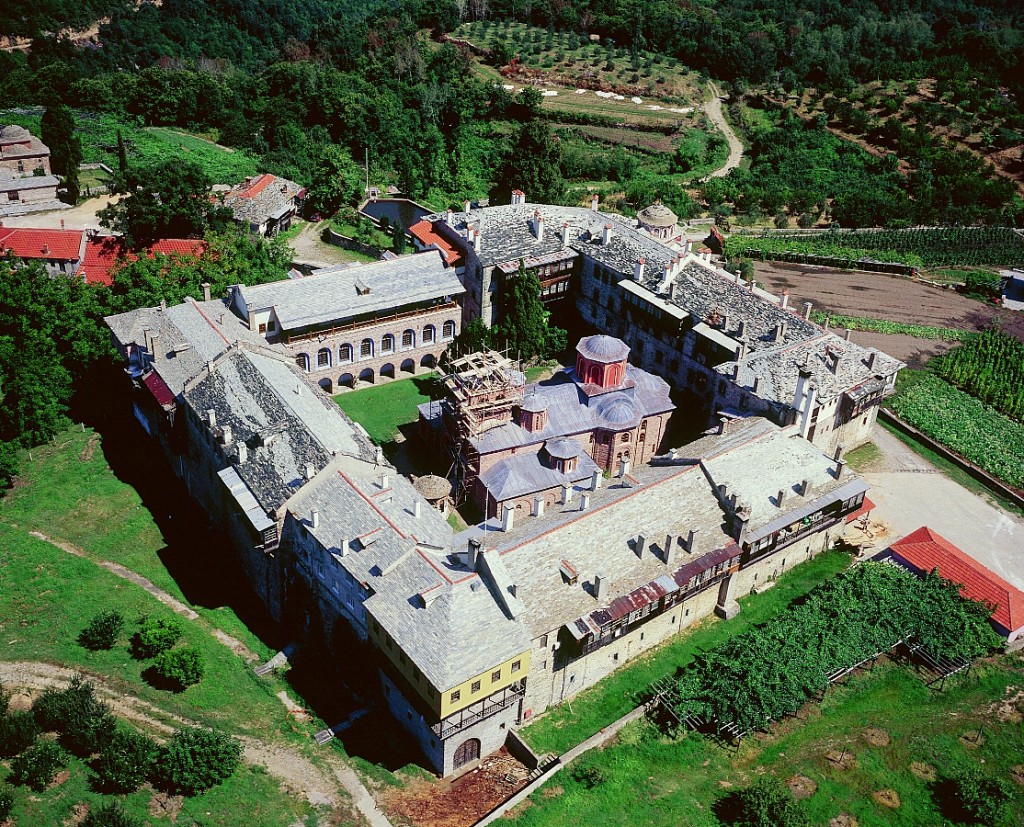
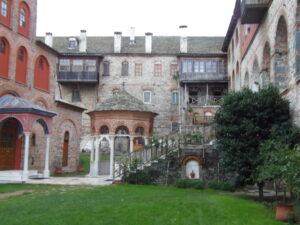
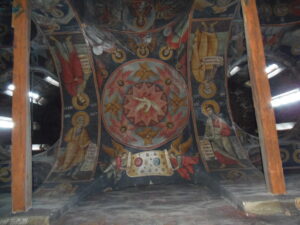
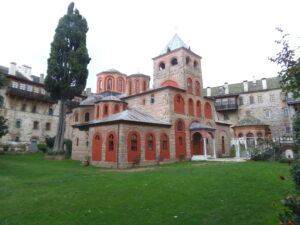
As can be easily seen from the above, after so many periods of reconstruction, but also partial destruction, which were not mentioned, it is difficult to see anything visible from the Byzantine monastery of Philotheos in our days. Only sporadically and in the midst of restoration work in our days, elements that could be placed in the Byzantine era can be distinguished. The monastery complex displays the usual almost square plan for monastic data, with the catholicon in the middle and the Tabernacle to the west of it, but integrated into the corresponding wing of the monastery. The catholicon is dedicated to the Annunciation of the Virgin Mary. The church architecturally belongs to the Athonite inscribed cruciform style. It was built in 1746, on the foundations of an older church, which had decayed. The rulers of Moldavia, Constantine Mavrokordatos and Gregory Ghikas, financially assisted in the construction with 6.600 aspra, so that not only the construction of the Catholicos and the bell tower, but also its iconography in 1752, as well as the illustration of the chapel of the Holy Forerunner, became possible. The illustration of the Catholicos is the work of the brothers Constantine and Athanasius from Korçë. Thirteen years later, in 1765, they also painted the austere. All we know about the old Catholicos is that it was in the style of a basilica. In fact, in a plan by Barski, who passed through the Monastery just two years before the construction of the new church, this basilica appears domed, with side choirs and an additional dome in the pronaos. The iconostasis was preserved from that temple, enriched with portable icons of Cretan Art in its epistylium.
Chapels
The chapel of the Holy Forerunner is the northern of the two chapels that flank the Catholicon. It was built in 1776 by the monks Gabriel and Neophytos, and it also has an elegant wooden carved iconostasis, crafted in 1786. Similarly, the chapel to the south is honored in the Synaxis of the Archangels with frescoes from 1752. A chapel, honored in the name of Saint Marina, also exists in the bell tower, while three other chapels are incorporated into the three wings of the complex, of the Holy Five Martyrs in the east, of Saint John Chrysostom and of Saint Nicholas in the west. Outside the enclosure are the chapels of the Nativity of the Virgin Mary, which on Mount Athos is also known as Panagouda, i.e. small Panagitsa, of the Three Hierarchs or of Saint Tryphon, as well as of All Saints, which is the cemetery church of the monastery. According to the monastery's shrine, the church was inaugurated and renovated in 1806 by the Ecumenical Patriarch Gregory V, however, the cornerstone of the church indicates the year of renovation as 1809, a year that does not correspond to the patriarchate of the said hierarch.
The Bank
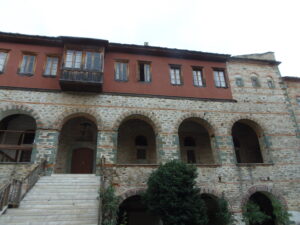
One of the buildings, which are considered to be among the oldest in the monastery, is the Tabernacle, which we know was expanded in the 16th century . This renovation was carried out at the expense of the king of Kakheti (present-day Georgia) and his son Alexander. An inscription dated 1540 should rather refer to the renovation of the building itself and not to its frescoes, which according to more recent studies should be placed between the years 1561 -1574. These are remarkable frescoes, which, however, are not preserved in good condition, due to the fire of 1871. They were painted in one phase, but stylistically, they seem to belong to two different painters. Between the Catholicos and the Tabernacle is the Vial of Sanctification, with frescoes from the end of the 18th century.
The library
The library occupies most of the northern wing. In addition to printed matter, it contains approximately 370 manuscripts, of which 54 are parchments. Most important of all is an illustrated tetragospel, considered one of the oldest on Mount Athos, with the evangelist Mark attributed as a philosopher. Sp. Lambros, during his work in the monastery at the end of the 19th century , counted 249 codices.
Portable images
The most important icons of the monastery are considered to be the Theotokos Glykofilousa, a two-faced icon with a representation of the Crucifixion on the back, which the tradition of the monastery considers to be pre-iconoclastic and to have arrived miraculously from Constantinople, as well as the Virgin Mary Gerontissa, which was also miraculously transferred from Nigrita. In fact, the legend considers the first icon to be an icon not made by hands, narrated by the Apostle Luke ... Both icons are located in the Catholicon. A large-sized brass campaign cross from the 11th century is also kept in the Catholicon. with representations of healing and military saints.
Relics of saints
In the sacristy, in addition to the right hand of Saint John Chrysostom, a piece of the Holy Wood is kept, a tribute to the monastery of Stefan Dousan, as early as 1347. In fact, in the past, a nail of the Crucifixion was also preserved, a gift from Emperor Nikephoros III Botaneiates, which was however transferred to the metochi of Thassos. Also, relics of saints are kept, such as part of the ischial bone of Saint Marina, part of the skull of Saint Mamanus, pieces of relics of the holy Bismyrian martyrs, the holy martyrs Isidore, Mardarius, Kirikos, Charalambos, James the Persian, Paraskevi and Tryphon, as well as part of the foot of Saint Panteleimon, a gift from Constantine XI Palaiologos.
Nowadays, the brotherhood of the monastery of Philotheos numbers approximately 80 monks, and occupies the 12th place in the hierarchy of the monasteries of Mount Athos.