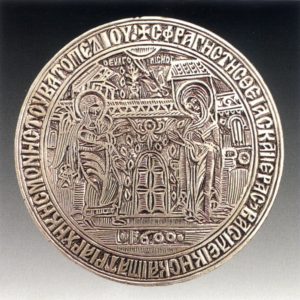
The history of the name of the Vatopedi Monastery
01.10.2020
The Holy Monastery of Vatopedi is one of the oldest monasteries that has survived to this day. It is built on the homonymous coast of the Athos peninsula, which is now called Mount Athos. It occupies the second place in the hierarchy of the monasteries of Mount Athos and is generally acknowledged to be the most beautiful monastery on Athos and one of the most beautiful monasteries in Greece.
It was built in the 10th century and contributed to the difficult times of the Turkish rule, participating both actively in the process of preserving national and religious consciousness by creating educational centers of the time such as the Athoniada school, and in the national struggle by contributing financially and serving as a retreat center and refuge for the fighters. Today, it offers significant charitable work, especially in northern Greece, by maintaining a multitude of institutions, while it holds a multitude of shares at its disposal.
According to tradition, on the site where the Vatopedi Monastery is located today, a chapel was built by Constantine the Great in the 4th century. This chapel was destroyed a few years later by Julian the Transgressor, only to be rebuilt by Theodosius the Great, when his son Arcadius was miraculously saved by the Most Holy Theotokos after a shipwreck. According to tradition, the sea miraculously carried him to the spot where the Vatopedi Monastery is today, where he was eventually discovered sleeping next to a bush, hence the name vato-paidi.
During the 10th century, according to the biographer of Athanasius the Athonite, three lords from Adrianople wanted to contribute financially, offering 9.000 gold coins to the Holy Monastery of the Great Lavra. Athanasius himself urged them to found a new monastery, indicating the location of the present monastery. Thus, from a document of Thomas the First, dated to the year 985, we know today that already at the end of the 10th century, there was an abbot in the monastery named Nicholas, which is also the oldest official written testimony about the founding of the Vatopedi Monastery.
With the Sigil of the Ecumenical Patriarch Demetrius I, the Holy Monastery of Vatopedi became coenobitic in 1990 AD. It has occupied the second place in the hierarchy of the Athonite Monasteries since the 11th century. A representative of the Monastery assumes the duties of Protopestatus of Mount Athos every five years. According to the Charter of Mount Athos, he, together with the representatives of the Holy Monasteries of Koutloumousi, Karakallos and Stavronikita, constitute the second permanent four Monasteries that, cyclically, every five years and for one year, constitute the Holy Epistatasia.