
Esfigmenou Monastery
01.11.2019
Designation
There is a difference of opinion about the etymology of the name of the monastery of Esphigmenou. The first version accepts that the name is due to a monk, monochiton, tightly wrapped in a rope , who for this reason bore the nickname Esphigmenou. The second comes from the location of the monastery, where in the bay in which it is built it seems to be enclosed by the neighboring hills. Indeed, the monastery is located at the NE end of the Athonite peninsula, it is the most remote monastery on this side and is enclosed by the hills of Zoodochos Pigi, Samaria and Gribovitsa. It is approximately six and a half hours' walk from Karyes.

Establishment
We do not know exactly when the monastery was founded. Tradition considers it a 5th century building , and attributes its foundation to Emperor Theodosius II and his sister Pulcheria. Inauthentic or questionable sources mention a certain Theoktistos as its abbot as early as 940. However, we can say with certainty that the monastery existed in 998, when in an unpublished document of the Vatopedi monastery we find the signature of the abbot Theodore. However, in these early documents the monastery is also referred to as Esfamenou . Since then, the succession of abbots has been preserved to a satisfactory extent up to the Ottoman conquest, which reveals the uninterrupted continuity of the monastery during the Byzantine period. In fact, some of them also served as First in the Holy Supervision.

Acne period
Not much information is available about the Byzantine period. What is commonly accepted is that the monastery experienced a long period of prosperity from the second half of the 13th century onwards. This was due to the sponsorship of the emperors of the Palaiologos dynasty, as well as the Serbian rulers Stefan Dušan and George Vranković. In fact, as early as the 11th century , the first concessions by Byzantine emperors of joint-stock establishments in Halkidiki, Strymon and Thessaloniki are attested. Also, the first known deeds specify the properties of the monastery within Mount Athos. However, from 1315 onwards, territorial disputes between the monastery and the adjacent monastery of Vatopedi are first attested, which even led to the destruction of its establishments. On the other hand, the monastery also experienced destruction, in the 14th century from fires, by pirates, while in 1534 it was also set on fire by the Turks. A similar destruction is said to have occurred in 1634.
Ottoman
During the Ottoman rule, the monastery fell into decline. At the same time, from 1527 onwards, conflicts began with the neighboring monastery of Zografou, while from 1562 onwards, the monastery was involved in property disputes with the also nearby monastery of Chilandari. The disputed properties were located in the areas of Vagenokamara, Giovanitsa, Loggos and Kakos Ryakas, i.e. areas around the monastery of Esphigmenou. In particular, the issue of Giovanitsa was pending until the end of the 18th century . In the mid-17th century , the monastery was in such poverty that it decided to sell the bond of two of its cells in Karyes, while from the beginning of the 18th century onwards, it would also resort to bequests. At the same time, the monastery faced problems with its meteochies in Achinos and Patriki of Serres. However, the monastery emerged from these issues strengthened, as they became the occasion for it to receive great support from Russia and the Transdanubian principalities, support that even amounted to the granting of shares. Calm would return to the monastery in 1797 when, in view of its coenobiation, Damaskinos, former metropolitan of Thessaloniki, and Gregory V, during the interval when he was not on the throne of the Ecumenical Patriarchate, undertook efforts to reconstruct it and return to it various of its properties.
More recent years and current regime
The last destruction that the monastery would suffer was in 1821, when Emman. Pappas came to the monastery to proclaim the revolution, which provoked the fury of the Turkish garrison there. In more recent times, the monastery did not accept the mutual lifting of the anathemas between the Roman Catholic and Orthodox Churches, which took place in 1964 during the meeting of Patriarch Athenagoras with Pope Paul VI of Rome, and was led to a state of excommunication from the rest of the Church. The Ecumenical Patriarchate did not want to use force to remove this entourage from the monastery and chose to install and recognize a new entourage in the Esphigmenite konaki of Karya. This is the reason why access to the monastery is now more difficult.
The monastery complex
The many gaps in our knowledge about the monastery are filled in by Gerasimos Smyrnakis, who was an Esphigmenite monk. In fact, since most of the renovation program was carried out just a few years before his settlement at the monastery and since he had also served as its abbot, he provides us with important information about dates, people, donations and traditions. Most of the buildings, therefore, of the current monastery complex date from between 1804–1861. The ground plan of the complex presents the shape of a parallelogram, with its long northern side essentially being washed by the sea. There is also the side door for those entering from the sea side, which is the old door of the monastery. Its main and later entrance is located in the middle of the south wing. Two marble columns from the legendary katholikon of the Pulcheria monastery, located approximately five hundred meters north of the current complex, have been walled in for a second use at this entrance. It forms a passageway, covered with folk art murals from 1861, while above it is the central tower of the wing, built in 1854. On its upper floor there is a bell tower with a clock on its four sides, which was built in Vienna in 1856. Another tower in the eastern wing is also part of the building program of this period. The monastery has five other towers in its perimeter and another corner tower is attested, which are probably the only relics of the Byzantine period.
The bottle
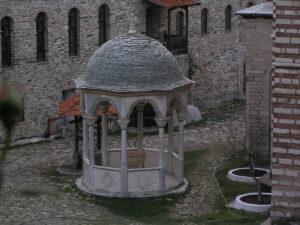
Opposite the entrance we find the cistern, built in 1815 by the then abbot Efthimios to replace the Byzantine one from the time of John V Kantakouzenos (1341-1391). Its dome is supported by eight marble columns and its base is surrounded by baroque marble breastworks.
The Catholic
The Catholicon, which is honored in the Ascension of the Savior, began to be erected in 1808 and was completed in 1811. It belongs to the complex four-column inscribed cruciform rhythm, of the Athonite type, that is, it also has two wide lateral niches for the spaciousness of the cantors at the two lecterns. The inauguration took place in 1811 by the Ecumenical Patriarch Gregory V. In the same year, the frescoes of the main church had already been completed, while in 1818 the Holy Altar was also painted. The entire painting is the work of the Galatian painters Benjamin, Zachariou and Makariou. The separation of the Holy Altar is achieved by an elaborately carved wooden, concave, high iconostasis, built in 1813, while the Holy Altar is also carved in wood, a work of 1810. The four main Despotic icons belong to the years 1813-1814, while the side icons of Saints Demetrius and George come from the earlier Catholicon and have gilded shirts, made in Russia in 1850. The wooden carved breastplates of the iconostasis depict scenes from the Old Testament, which present a theological correspondence with each of the superimposed Despotic icons. The most important icon of the monastery is the Theotokos, depicted as Rodon the Amaranth. In 1841, the current inner narthex was added, and in 1854, the outer narthex, pronaos and peristyle porch were added.

Chapels
Two chapels adjoin the Catholicon. The northern one is honored in the Synaxis of the Incorporeal and the southern one in the Presentation of the Theotokos. On the southern wall of the southern chapel is the rather rare representation depicting the articles of the Creed. In addition to these, there are eight other chapels in the monastery complex: of Saints Anargyroi in the hospital, of Saint Anthimos next to the abbot's office, of Saint George in the SE corner, of Saints Constantine and Helen in the bell tower, of Saint Nile the Wise, of Saint Nile the Myrrh-Bearer, of Saint John the Merciful. In the middle of the upper floor of the eastern wing is the chapel of Saint Gregory Palamas. The prominent position of the chapel is justified by the fact that Saint Gregory had resided for a considerable period in the monastery. In front of the same wing there is also a holy water font of Saint Gregory.
The bank
According to tradition, which requires the abbot of the monastery to be able to see the sacred altar during meals, the Tabernacle is located to the west of the Katholikon. It is an elongated wooden-roofed building with three arches on the west wall. Its interior is documented, but the frescoes are in poor condition. An inscription on the west wall gives the date 1810 as the year of renovation, which apparently included the complete repainting of the whole. The original decoration covered all surfaces and belongs to more than one phase. On the outside there is a fountain from 1804.
The sacristy
The sacristy and the library are located above Liti. Among the relics, the most important are a small mosaic image of Jesus in full body, part of the battle scene of Napoleon Bonaparte, which after a long history ended up in the monastery, the banner of the 1821 revolution of Emmanuel Pappas, while most of its relics date back to the Ottoman period and onwards. It also has a section of Holy Wood, as well as the Holy Relics of 56 saints. Among the other treasures are the left foot of Saint Mary Magdalene, the casket of Saint James the Brother and the Relics of Saints Parthenios, Bishop of Lampsacus, George the Great Martyr, Anastasia of Pharmakolytria, Alexios the Man of God, etc. There is a strange confusion regarding the number of printed materials in the library, for which Smyrnakis Bookshops that, while in 1837 it numbered approximately 1500 manuscript codices, in 1880, that is, during his time, there were 320, of which 71 were parchments. This is also the number of codices recorded by Sp. Lambros at about the same time.
Seats
The monastery has seven Seats. On the hill east of the monastery is the Seat of the Life-Giving Spring, on the eastern edge of the bay is the church of Saints Theodore, while on the hillside, above the arsana, is the church of Saint Anthony of Kiev Cave. The name is due to a legend, which has Saint Anthony of Pechersk, a Russian ascetic of the mid-11th century , leaving the great Lavra of the Kiev Caves and coming to become a monk in a cave in the area, where the church in question is located approximately. Finally, another not fully confirmed location is a ruined church, which according to Smyrnakis was the Catholicon of the 5th century monastery, which dates back to Pulcheria. This is a part of the sanctuary's niche, as well as four unlined columns, which were identified and placed there as early as the 19th century . At this point there is now a Seat of Saint Demetrius.
The monks
The number of monks within the monastery, which constitutes the so-called old and schismatic group from the ranks of the Orthodox Church, is unclear, but is considered large. The new and in communion with the Body of the Church group, which resides in the Konaki of Karya, numbers no more than ten monks. The monastery occupies the 18th place in the Order of the monasteries of Mount Athos.